


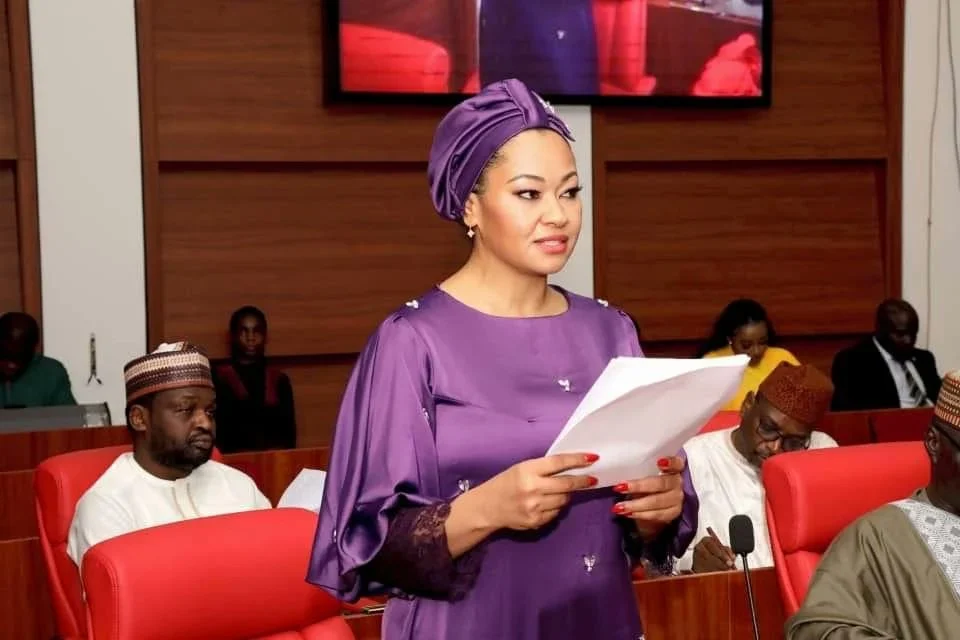
On Monday, the Senate praised the Court of Appeal’s decision to uphold its suspension of Kogi Central lawmaker Natasha Akpoti-Uduaghan, viewing the ruling as a strong endorsement of legislative independence and the separation of powers.
The Senate emphasized that its authority to discipline its members is constitutionally guaranteed and can only be challenged through judicial review in cases of clear constitutional or legal violations.
This reaction followed the Abuja Division of the Court of Appeal’s judgment, which was delivered by a three-member panel in appeal case CA/ABJ/CV/1107/2025. The court unanimously ruled that Akpoti-Uduaghan’s suspension did not violate her parliamentary privileges or constitutional rights.
While the court upheld the suspension, it also granted her a partial victory by striking out the N5 million fine and apology order related to contempt proceedings, which she had consistently argued were illegal and unconstitutional.
The dispute originated on February 20, 2025, when Senate President Godswill Akpabio ruled Akpoti-Uduaghan out of order during plenary after she declined to speak from her reassigned seat. This led to her suspension and referral to the Senate Committee on Ethics, Privileges, and Public Petitions, igniting a legal challenge that tested the limits of legislative discipline and judicial oversight.
In the lead judgment, Justice A. B. Muhammed stated that Akpabio had acted correctly by denying the senator the floor under the Senate Standing Rules, as she was not seated in her designated position during the session.
The court clarified that the Senate President has the authority under the rules to allocate and reassign seats, and members are only permitted to speak from their official seats. Justice Muhammed also noted that, according to Section 66(4) of the Senate Standing Rules, the Senate has the power to discipline members who disrupt proceedings to uphold order and decorum.
The appellate court dismissed Akpoti-Uduaghan’s claim of inadequate notice, ruling it was untenable. It also held that the Federal High Court should have declined jurisdiction, affirming that the Senate acted within its internal rules when suspending a member for breaching legislative procedures.
The court further explained that once the senator was aware of her seat reassignment, she should have moved to her new seat, and that the Senate was justified in invoking Order Six, Rule Two, when she refused to comply.
However, the court rejected her claim that her suspension violated an ex parte order issued by Justice Obiora Egwuatu, ruling that the order expired after the judge recused himself, and the case was subsequently heard before Justice Binta Nyako.
The court also ruled against the contempt charges and the N5 million fine imposed by Justice Nyako, citing the failure to serve Forms 48 and 49 on the senator as a procedural flaw that invalidated the sanctions.
Yemi Adaramodu, Chairman of the Senate Committee on Media and Public Affairs, lauded the judgment, stating, “This ruling reaffirms parliamentary independence and the separation of powers. It confirms that the Senate’s disciplinary powers are constitutionally protected and can only be challenged if there is a clear constitutional or legal breach.”
He added, “Disciplinary actions taken lawfully by the Senate do not infringe on a member’s fundamental rights; such rights are only activated when procedural rules are violated.”
Attempts to reach Akpoti-Uduaghan’s lead lawyer, West Idahosa, for comment were unsuccessful, as he did not respond to calls or messages. However, sources close to her legal team described the ruling as a clear affirmation of due process and the rule of law, emphasizing that legislative disciplinary powers must be exercised within constitutional and procedural boundaries.
A source stated, “The Court of Appeal has reinforced the principle that no authority is above the law. When due process is ignored, the outcome cannot stand.